What Makes Hot-Poured Chili Oil Different?
How Shaanxi youpo lazi is made, why the pour matters, how it differs from chili crisp, and why the category is growing fast.
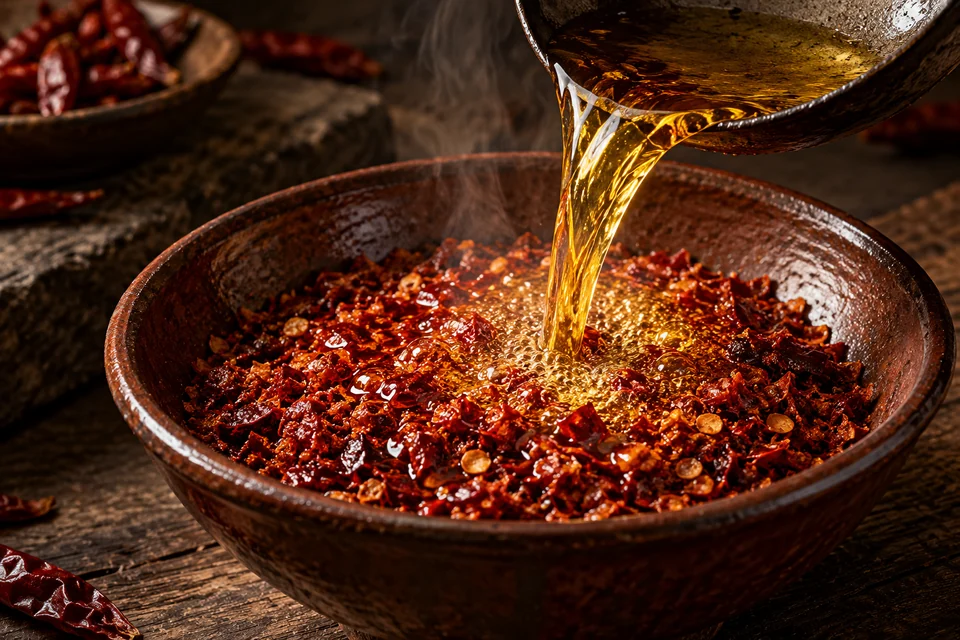
Hot-poured chili oil, youpo lazi (油泼辣子) in Shaanxi, is made by pouring hot oil over dried chili flakes. Unlike strained chili oil, the flakes stay in the jar, so every spoonful has both oil and chili.
How it is made
Dried red chili is destemmed and crushed into coarse flakes. Rapeseed oil, the traditional oil of the Guanzhong Plain, is heated to around 200 °C and poured over the flakes in two or three stages. The first, hottest pour brings out aroma and a deep red color; the later, cooler pours keep the chili from scorching. Salt and sometimes a little toasted sesame finish it.
Why the chili variety matters
Because the flakes are eaten, the chili itself carries the flavor. Shaanxi line chili from areas such as Xingping is slender and deep red, with thick flesh and natural oiliness, so it gives a fragrant chili oil with moderate heat rather than a sharp burn. That is why Xi’an diners describe good youpo lazi as “aroma first, heat second”.
Chili oil vs chili crisp
Chili crisp adds deep-fried garlic, shallot or soybeans for crunch and more savory seasoning. Shaanxi chili oil is simpler, with chili, oil and salt, and its flakes are soft rather than crunchy. It is the condiment poured over biangbiang noodles, liangpi and roujiamo.
A fast-growing category
Chili oil and chili crisp have moved from Chinese kitchens into mainstream menus worldwide. Datassential reported in 2023 that chili crisp’s presence on US restaurant menus grew 2,999% in four years. Market researchers put growth in the global hot sauce market at about 8–10% a year, with Asia Pacific the fastest-growing region at roughly 10% a year (Fortune Business Insights; Global Market Insights). For brands and distributors, a regional style such as Shaanxi youpo lazi is a way to stand out in a category that buyers are already looking for.
What to compare when developing a product
For a private-label chili oil, the main variables are the chili variety and its heat, flake size (fine, medium or coarse, roughly 1–5 mm), the oil, the pour temperature, and the flake-to-oil ratio. Small changes in each give clearly different products, which is why we confirm them on samples before production.