From Xingping Fields to the Jar: How We Source Shaanxi Chili
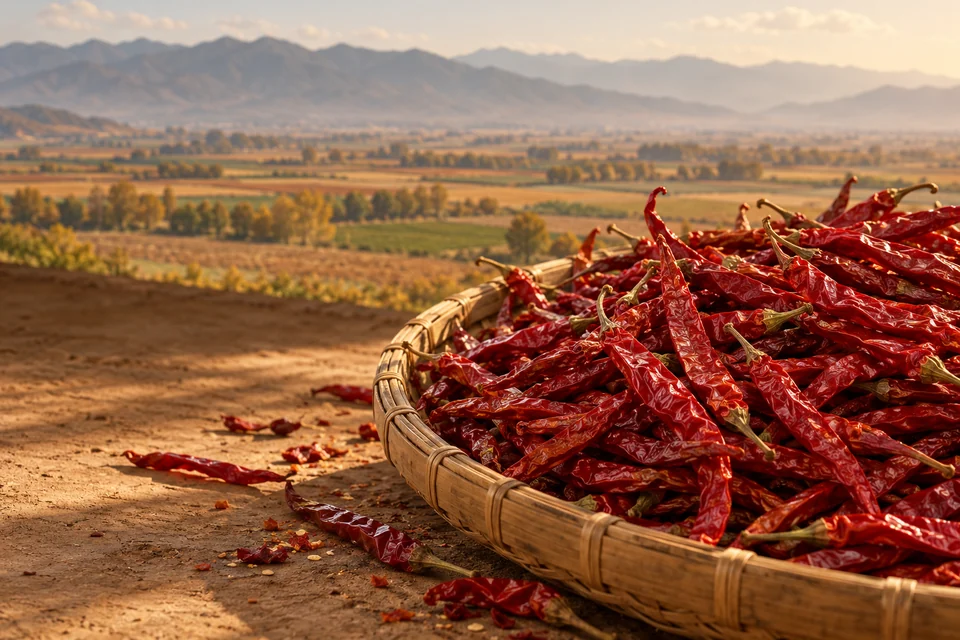
Where Shaanxi line chili grows, how farmers harvest and dry it, and what we check before it becomes chili oil.
Xingping is a county-level city in Xianyang, on the Guanzhong Plain about 50 km west of Xi’an. Its loess soil, dry autumns and long chili-growing tradition make it one of the best-known chili areas in Shaanxi. Xingping chili is protected as a Chinese geographical indication, and in 2026 the Shaanxi Xingping chili cultivation system was listed among China’s Important Agricultural Heritage Systems.
The chili: Shaanxi line chili
The local variety is a line chili (线辣椒): long, slender pods that ripen to a deep red, with thick flesh and natural oiliness. Locals call chili from this region Qin chili (秦椒). It is valued for aroma and color more than raw heat, which is exactly what a hot-poured chili oil needs.
Working with local farmers
Most Shaanxi chili is still grown by family farms on small plots, and our supply works the same way. We buy from about 120 partner farming households and cooperatives around Xingping, covering roughly 1,500 mu (about 100 hectares). Before planting we agree on varieties with them; at harvest we buy by grade at a price agreed in advance, so farmers know what good chili is worth and we know where every lot came from.
Harvest and drying
Pods are picked by hand from late summer into autumn as they turn fully red. Within 48 hours of picking they go into low-temperature drying rooms at about 50 °C, the method set out in the Xingping chili geographical-indication specification. Slow, even drying keeps the color bright and the aroma intact, and avoids the mold risk of drying on open ground in wet weather.
What we check on arrival
Each lot is recorded with the farmer or cooperative and checked for moisture, color, foreign matter and mold. Lots that fail are rejected. Chili is also screened for illegal dyes such as Sudan red and for aflatoxin B1. Accepted lots get a lot number that follows the chili through crushing, the hot pour and filling, so any finished jar can be traced back to its source.
Why it matters for buyers
For a brand or distributor, a clear origin is a selling point and a safety measure at the same time. You can tell customers where the chili is grown, and you can trace any batch if a question comes up. That matters more as the market grows: Southeast Asia’s sauces and condiments market is expanding about 8.44% a year (MarkNtel Advisors), and China’s chili oil and sauce exports to the region rose from about US$265 million in 2024 to US$297 million in 2025 (UN Comtrade), so buyers increasingly compare suppliers on origin and traceability, not price alone. Ask us for a sourcing sheet with your samples.